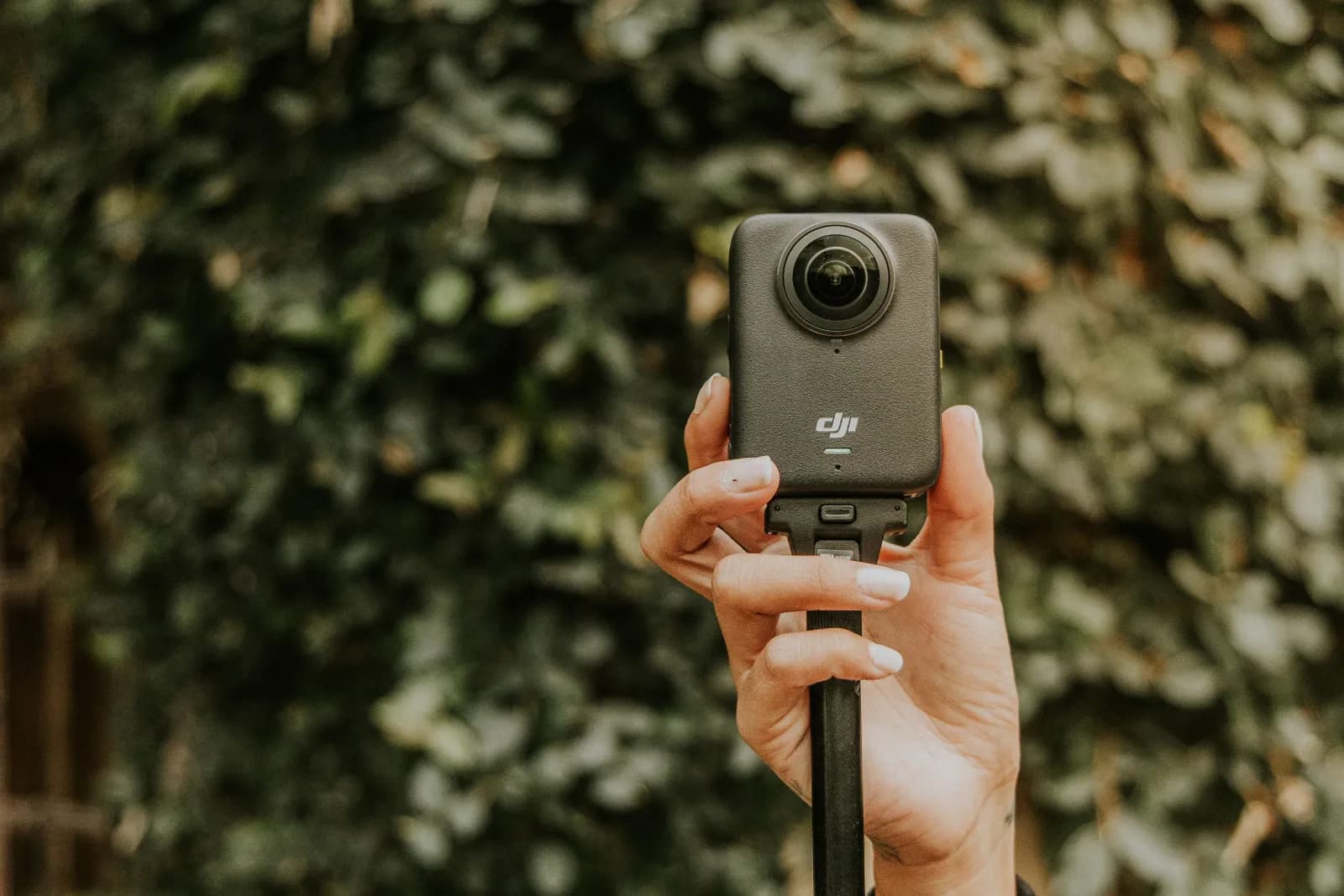
You can look anywhere. You just cannot look into it.
Put on a headset, open a 360 video, and the first few seconds are genuinely impressive. You turn your head and the world turns with you. Then something quietly disappoints. The room you are standing in has no room in it. The wall behind the table is not behind the table. It sits on the same surface, at the same distance, like a painting on the inside of a planetarium dome.
That is not a fault in your camera and it is not a bad export. Almost every 360 camera you can buy records in mono: one single view of the world, wrapped around you. You get direction, but you do not get distance.
Two lenses, but never two eyes
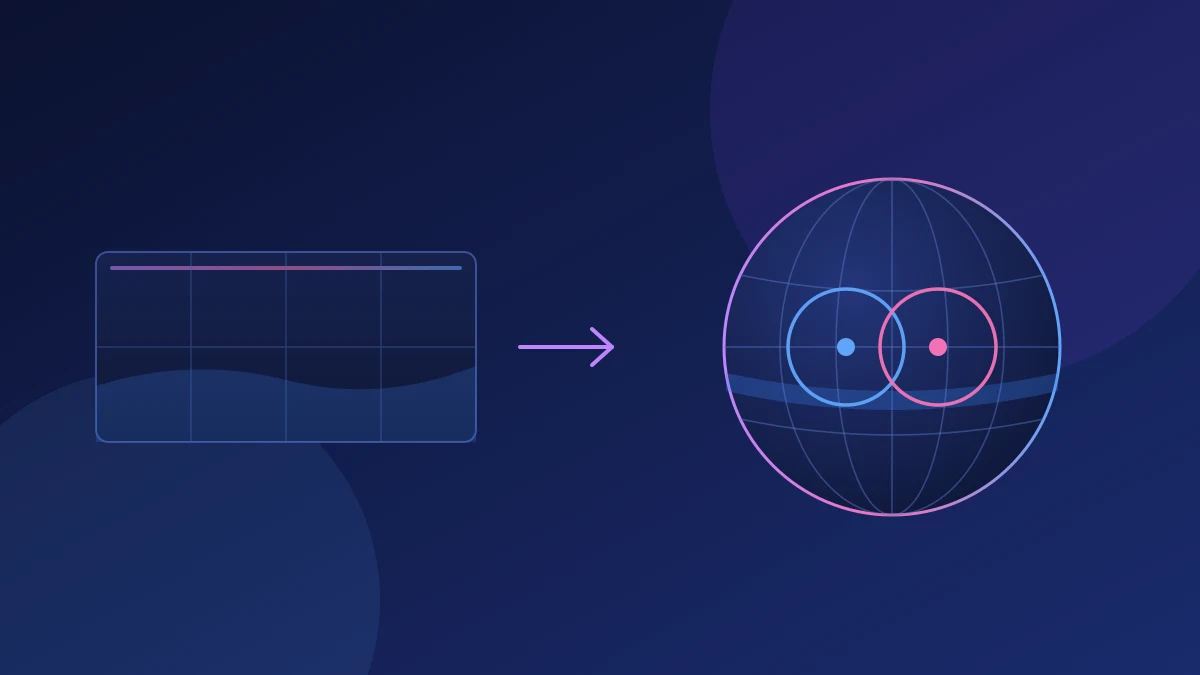
This is the part that surprises most people. Your 360 camera has two lenses, so it seems fair to assume it already sees the world twice, the way you do. It does not.
The two lenses point in opposite directions. Each one covers roughly half of the world, and the software stitches those two halves into one seamless sphere. At no point do both lenses look at the same thing from two slightly different positions, and that is the one thing that would create depth. Your eyes sit side by side, a few centimetres apart, both facing forward. A 360 camera is built to avoid exactly that overlap, because when your goal is to cover everything, overlap is wasted sensor.
So: two lenses, one viewpoint. One eye, in practice.
What your brain is missing
Depth in a headset comes from parallax. Your left eye and your right eye see the same scene from slightly different angles, and near things shift more between those two views than far things do. Your brain reads that shift as distance, without you ever thinking about it.
In a mono 360 video, both of your eyes are shown the identical picture. The shift is zero everywhere, and your brain reads that as "everything is equally far away".
Here is the strange part: this bothers people more in 360 than in ordinary flat video, not less. When you watch a flat video you have already accepted that you are looking at a screen. In 360, everything else is telling you that you are somewhere. The sound, the direction, the way the world holds still when you turn. Only the depth is missing, so it is the one thing that stands out.
What a stereo conversion actually adds
Converting mono to stereo means building the second eye that was never filmed. We work out the distance of every pixel in every single frame, then use that depth to generate a second view of the scene from a slightly different position. Near objects move further, distant objects barely move, and wherever the shift uncovers something that had been hidden behind an object, that gap has to be filled in so you never notice it was there.
What you get back is the same place you filmed, with the space put back into it. The table has a front and a back. The corridor goes somewhere. Lean a little and the scene behaves the way your body expects.
Why a sphere is harder than a rectangle
With a normal flat video, you build the second eye by shifting things sideways. That works because there is one forward direction and it never changes.
On a full sphere there is no single forward. If you simply shifted every pixel sideways, the video would fall apart the moment you turned your head. Look 90 degrees to the side and the shift would run along your line of sight instead of across it, so the depth would flatten out to nothing. Turn all the way around and it gets worse than nothing: your left eye would be seeing what belongs to your right eye. Close things would look far away and far things would look close.
The way around this is to build the pair for every direction at once, so that whichever way you turn, your two eyes are always separated across your view rather than along it. It is genuinely different geometry from the flat case, which is why a 360 video follows its own route through our pipeline instead of reusing the normal one.
Resolution: the sphere is bigger than it looks
One practical thing worth knowing before you shoot. A 360 video has to spread its pixels over everything around you, but you only ever look at a small slice of it at a time.
A 5.7K 360 video is about 5760 pixels wide, spread across a full 360 degrees. That works out at 16 pixels per degree. Your view through a headset covers roughly 100 degrees of that, depending on the model, so you are really looking at around 1600 pixels: less than an ordinary 1080p video, stretched across your entire field of view. Shoot the same scene in 8K and the same sum gives you about 2100 pixels.
So use the highest setting your camera has. In 360 that is not a luxury. It matters considerably more than it does for flat video, and no conversion can put back detail that was never recorded.
What you need to bring
A real 360 source. We check the shape of your file, because a true 360 video is exactly twice as wide as it is tall: 360 degrees across, 180 degrees from floor to ceiling. Anything with a different shape is not a sphere, and no software can invent the parts of the world that were never in front of a lens.
The stitched export from an Insta360, a GoPro Max or a Ricoh Theta is already the right shape. Upload it exactly as it comes out.
Watching it afterwards
We write the 3D metadata into the finished file, so your headset knows it is looking at a sphere with a separate picture for each eye, instead of one flat, stretched image. Open your library in the headset browser, type the six-character code we show next to your video, and it plays. If you also put the file on YouTube, upload it exactly as you received it: re-encoding it first strips that metadata straight back out, and then it plays flat again.
Is it worth converting your archive?
If your 360 footage is of a place, it usually is. Rooms, landscapes, venues, workshops, anywhere the value is in being there. Depth is what turns a view of a place into a sense of standing in it.
If the footage is mostly of a wide open sky, a distant horizon or a flat surface, expect less. There simply is not much depth in the scene to recover, and an honest conversion will not pretend otherwise. Try one clip first and judge it in the headset, not on a monitor. Depth is the one thing a flat screen cannot show you.