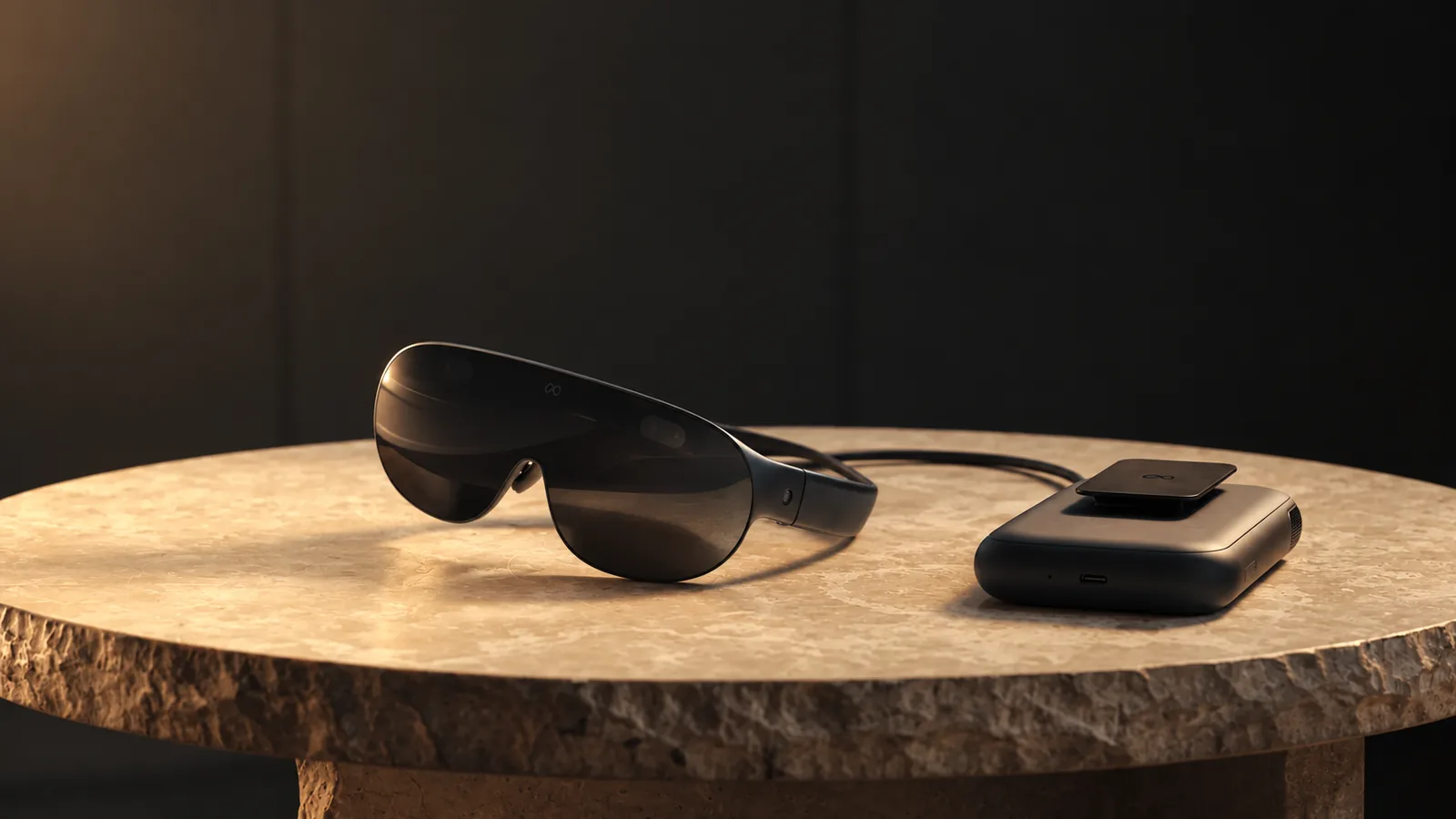
At Meta Connect on 23 September 2026, Meta did not announce a new Quest. It announced something that looks like a pair of sunglasses. Meta VR Glasses weigh about 100 grams, show films in Dolby Vision on micro-OLED displays, and run everything a Quest 3 runs. They ship in spring 2027 for $1,299.99. Here is what was announced, what is still unknown, and what it means if you want to watch your own videos in 3D.
What Meta announced
Meta VR Glasses are a two-part device. The glasses on your face hold the displays, lenses, cameras and speakers. Everything heavy sits in a separate compute puck of about 300 grams that clips to your belt, pocket or bag, connected by a thin optical cable. Meta describes the result as "a cinema, a workspace, and a console" in one device, and the order of those three words is telling: film comes first.
The US price is $1,299.99 for the 128 GB version. Pre-orders are not open yet and there is no exact date beyond "spring 2027". The launch countries include the US and the UK, and in Europe the Netherlands, Belgium, Germany, France, Spain, Italy, Austria, Switzerland, Ireland, Poland and the Nordic countries. European prices have not been announced.
The key specs at a glance
- Weight: about 100 grams on your face, which Meta calls "five times lighter than Meta Quest 3". The puck adds about 300 grams, but in your pocket rather than on your head.
- Displays: micro-OLED, 2,412 × 2,288 pixels per eye at 120 Hz, with HDR and Dolby Vision. Meta markets this as a "5K Infinite Display" at about 37 pixels per degree, the sharpest image of any Meta headset so far.
- Field of view: roughly 70° horizontal by 66° vertical, with open sides so you still see the room around you. That is clearly narrower than the 110° × 96° of Quest 3.
- Chip and storage: Qualcomm Snapdragon Reality Elite in the puck, 12 GB of memory, 128 GB of storage and a microSD slot.
- Battery: around 3 hours of use per charge, and you can charge while you watch.
- Controls: eye tracking and hand gestures. There are no controllers in the box; Touch Plus controllers are sold separately, and your existing Quest 3 or 3S controllers also work.
- Software: the same operating system as Quest 3, so the whole Quest catalogue of apps and games comes along.
A headset that leads with film
For years, VR headsets were sold on games. This one is sold on cinema. Meta VR Glasses are the first VR device to be IMAX Enhanced certified. Disney+ is bringing 3D films to Meta's headsets from November, including Marvel titles, Peacock adds 3D versions of its content, and a Lionsgate 3D catalogue is included. The usual streaming apps are there too, from YouTube and Prime Video to HBO Max and Paramount+.
That matters beyond Meta's own store. When the biggest headset maker positions its flagship as a personal 3D cinema, it tells you where the category is heading: fewer controllers, more sitting back and watching.
Why these specs suit 3D video
- Contrast. Micro-OLED shows real black instead of glowing grey. Depth is easier to read when dark areas are genuinely dark, and night scenes stop looking washed out.
- Sharpness. More pixels per degree means fine detail survives, which is exactly where a 3D image either convinces you or falls apart: hair, leaves, the edge of a face against the background.
- Comfort. At 100 grams you can watch a whole film, or an hour of family videos, without the pressure on your face that heavier headsets build up.
- The field of view is less of an issue for film. A narrower view matters in games, where things come at you from the side. A film plays on a virtual screen in front of you, and that screen fits comfortably inside 70°.
The 3D gap: your own videos
There is a catch in all of this. The 3D films from Disney, IMAX and Lionsgate were produced in 3D by studios with the budget to do it. The videos that matter most to you were not. Your wedding, your holidays, your children's first steps, the drone flight over your favourite coast: all of it was filmed in 2D, on a phone or an ordinary camera. On the best 3D display Meta has ever made, those videos still play as a flat rectangle.
That is the gap Xclusive VR closes.
What Xclusive VR adds: your 2D videos in real 3D
We convert ordinary 2D video into true stereoscopic 3D. Our AI measures depth in every frame and builds a separate image for each eye, so people and objects stand out from the background the way they did when you were there. You do not need a 3D camera, and you do not need to film anything again: the videos you already have are the source.
- Any video you already have. Phone footage, camera footage, drone shots, old family videos. Almost every common codec works, up to 8K, including HDR.
- Depth that stays calm. No flicker between frames and stable edges in motion, which is what makes the difference between a 3D effect you notice and one you forget about because it simply looks real.
- Quality that outlasts your headset. A paid conversion renders up to 4K per eye (8K side-by-side), keeps your HDR and your own frame rate up to 60 fps. That is more detail than Meta VR Glasses can show, so what you convert today will not need converting again when you upgrade.
- For the headset you have now, and the next one. Every conversion gives you full side-by-side 3D for Meta Quest, and spatial video (MV-HEVC) for Apple Vision Pro. Because Meta VR Glasses run the same software as Quest 3, the same videos are made for them too.
- Nothing to install or copy. We host the result and stream it to the browser in your headset. You open xclusivevr.com/watch, type a short code, and it plays. Pair your headset once and your whole library is one tap away. If you would rather keep the file, you can download it in full quality.
- Private by default. Nobody else sees your upload. You decide who watches through private share links you can switch off again, and your footage is never used to train anything.
- More than flat video. VR180 and 360° footage can be converted to 3D as well, for the whole sphere.
How it works
- Upload your video from your browser. Your first 2 minutes are free, without a credit card.
- We convert and host it. A short clip is usually ready within minutes; we email you the moment it is.
- Watch it in your headset. Open the headset browser, go to xclusivevr.com/watch and enter your code. On a Quest it opens in your own 3D cinema.
Converting a full video is a one-time purchase, no subscription: bundles start at €11 for 15 minutes, or you pay for a single video.
We will test the whole flow on Meta VR Glasses on the first day they are available and update this article with what we find.
What we do not know yet
- European prices and the exact date. Only the US price and "spring 2027" are official. With VAT added, expect European prices to end up above a straight conversion.
- How they feel after an hour. Weight on paper is one thing; the cable, the puck and the fit on your nose are another. Nobody outside Meta has worn them for a full film yet.
- Prescription lenses. For a device you wear like glasses, this is an obvious question, and there is no detailed answer yet.
- Browser playback in detail. The software is shared with Quest 3, but we will only confirm that our player behaves identically once we have tested it on the real device.
Should you wait for them?
If you already own a Quest 3 or 3S, there is no reason to put anything on hold. Everything you watch or convert now plays on the headset you have, and because the glasses share the same software, it comes with you when you switch. If you have been waiting for a headset that is light enough to watch films in comfortably, spring 2027 is worth marking in your calendar.
Try it with your own video
You do not have to wait until spring 2027 to see your own memories in 3D. Pick a video that means something to you, and watch it on the Quest or Vision Pro you have today. Your first 2 minutes are free, without a credit card, and the result is in your headset a few minutes later. When you move to Meta VR Glasses, your library comes with you.
Xclusive VR is not affiliated with Meta. The image at the top of this article is an illustration, not an official product photo. The specifications come from Meta's announcement and from hands-on coverage by UploadVR and Road to VR, and may change before launch.